
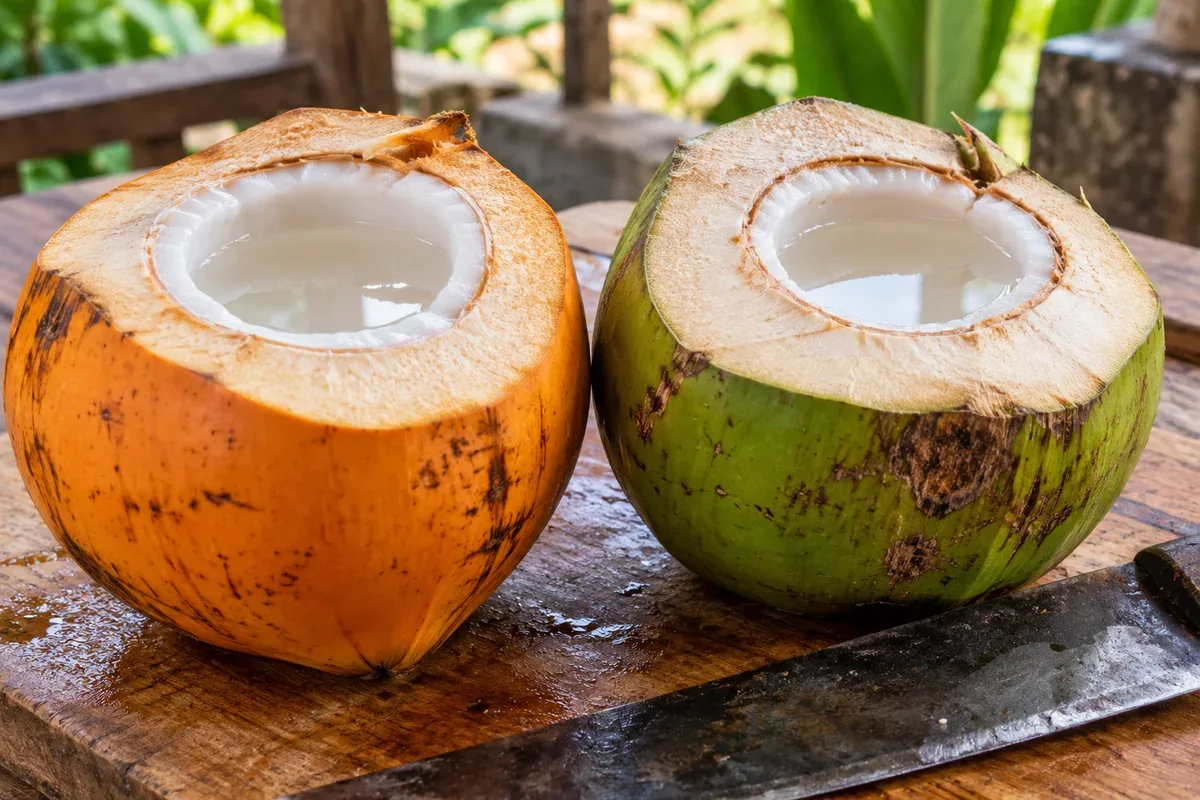
King coconut water is not just coconut water from an orange nut. Thambili is its own variety, Cocos nucifera var. aurantiaca, and a paper in the Coconut Community's journal describes it as "said to have originated in Sri Lanka". If you grew up here, you already know the difference by taste. It's sweeter and softer than the water from a green coconut, and for once the lab agrees with the tongue.
This guide covers what's actually in a glass, what it can and can't do for you, who should be careful with it, and how to choose between a fresh nut and a can.
How it differs from green coconut water
A 2024 study in Food Chemistry Advances compared tender coconut water from several varieties grown in northern Sri Lanka, all harvested at five to seven months. King coconut had among the highest sugar content (63.58 mg per ml, which works out to about 6.4 g per 100 ml), the highest total soluble solids at 5.0 °Brix, and the most protein. Its total phenolic content and antioxidant activity were also among the highest of the varieties tested.
That is one study, in one region, and the numbers move with age. Thambili changes as the nut matures, getting sweeter and less mineral-rich between six and eight months, so the one you drink in Colombo this week may not taste like the one you had in Kurunegala last month. Both are "right".
What's in a glass
Apart from the first row, the figures below are for coconut water in general, not king coconut alone. Treat them as a range, because that's what they are.
| Per 100 ml or 100 g | Figure | Source |
|---|---|---|
| Sugar, king coconut (5 to 7 months) | About 6.4 g | Shayanthavi et al., 2024 |
| Sugar, coconut water (young vs mature) | 5.23 g vs 3.42 g | Yong et al., 2009 review |
| Potassium, coconut water | About 204 to 312 mg | Yong et al., 2009 review |
| Packaged, unsweetened coconut water | About 18 kcal, 165 mg potassium, 26 mg sodium | USDA data, via MyFoodData |
The takeaway: coconut water is rich in potassium, modest in sodium, and carries real sugar. King coconut sits at the sweeter end.
The honest benefits
Hydration is the real one. In a 2012 trial with 12 exercise-trained men, coconut water rehydrated them about as well as a sports drink or plain bottled water, with little difference in performance afterwards. Worth knowing: the same men reported more bloating and stomach upset on coconut water. It works. It isn't magic, and gulping a litre after a hard session may not sit well.
Electrolytes, mainly potassium. That is what makes it a good choice on a hot day, and also why the next section exists.
Antioxidants, with a caveat. The 2024 study measured antioxidant activity in the water itself. That tells you what's in the glass, not what it does once you drink it.
What we won't tell you: that it cures gastritis, melts weight or does anything for your skin. We looked, and we found no clinical trials that support those claims.
Who should be careful
People with kidney disease, or on certain blood pressure medicines. The US National Institutes of Health notes that in people whose kidneys struggle to clear potassium, or who take ACE inhibitors or potassium-sparing diuretics, even ordinary dietary potassium can cause hyperkalaemia, a dangerously high blood potassium level. This isn't theoretical. A 2018 case report described a 78-year-old man who developed severe hyperkalaemia and paralysis after a week of drinking two to four servings of king coconut water a day, on top of undiagnosed kidney disease, diabetes and medication that raises potassium. If your doctor has told you to watch potassium, ask before you make thambili a daily habit.
People with diabetes. On the 2024 study's figures, a 250 ml glass of king coconut water carries around 16 g of sugar. For context, the WHO's stricter target for free sugars is below about 25 g a day. Natural doesn't mean it won't raise your blood glucose. Count it as a sweet drink, and check with your diabetes team.
Anyone drinking it by the litre. Even healthy people can overdo it. A published case report described a 42-year-old man who drank eight 11-ounce bottles of coconut water over a day of tennis in the heat before collapsing. One or two glasses is a drink. Eight bottles is a dose.
Fresh or canned?
A fresh nut, cut in front of you, is the benchmark, and we're not going to pretend otherwise. But drink it straight away. Once the nut is opened, enzymes in the water react with oxygen and it starts to lose flavour, and can turn pink. A bottle of cut coconut water in the fridge is already on the clock.
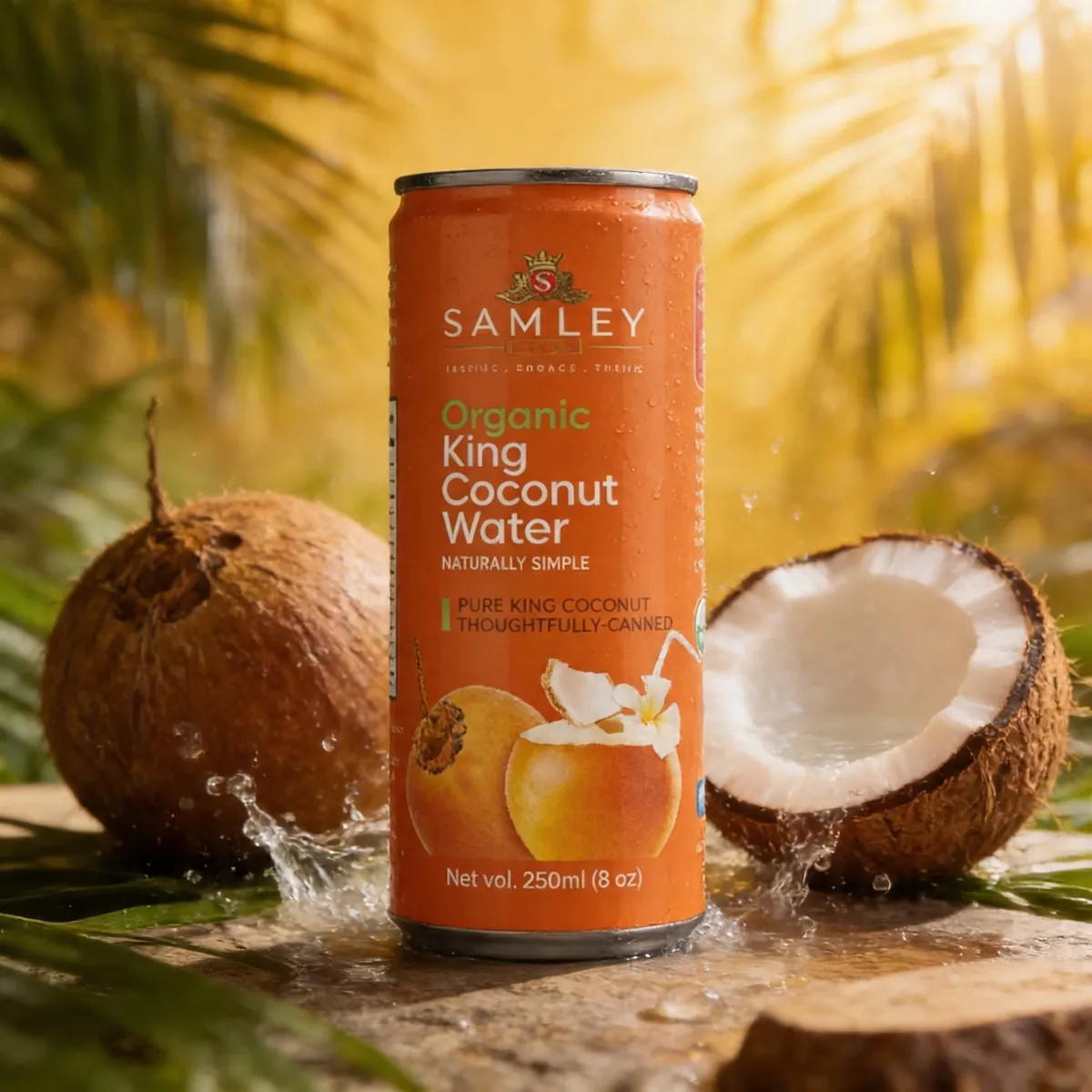
Packaged king coconut water has a tricky job. Coconut water's pH runs from roughly 4.8 to 5.7 depending on maturity, above the 4.6 line that makes it a low-acid food in US FDA terms, so to be safe at room temperature it has to be processed to commercial sterility. Ours is organic king coconut water, a single ingredient with nothing added, processed so it keeps unopened in the cupboard without preservatives or a cold chain. Check the best-before date on the can. It won't taste exactly like a nut cut at the roadside. What it gives you is thambili when there's no stall nearby, whether you're in a Colombo office or a flat in London.
Why the price moves
Prices change too often to print. What moves them is steadier:
- Last year's weather. A 2026 study of Sri Lanka's coconut sector found that rainfall in the previous year was the strongest predictor of production, and that a 1°C rise in the previous year's temperature pushed coconut prices up by about LKR 36 a nut. Drought hits your wallet a year late.
- Season. King coconut is seasonal, so supply tightens at some times of year.
- Export demand. Fresh king coconuts are exported too, so the nut at your roadside stall competes with overseas buyers.
- Fresh vs packaged. A can carries the cost of processing, sterilising, packaging and, for organic, certification. You're paying for the drink to still be good months from now.
What to look for on the label
- Ingredients: king coconut water, and nothing else. No added sugar, no "from concentrate" unless you're fine with that.
- Organic: if it says organic, look for the certifier's mark.
- How it keeps: "keep refrigerated" means it relies on the cold chain; a shelf-stable can or carton has been processed to last at room temperature.
- Serving size: a bigger pack is more sugar and more potassium. Do the sum for your own needs.
Quick answers
Can you eat the flesh of a king coconut? Yes. The soft kernel is edible, and it thickens as the nut matures; the researchers who tracked king coconut from six to eight months measured kernel weight and thickness increasing significantly over that time.
Is it OK to drink every day? For healthy adults with normal kidneys, a glass a day is an ordinary drink. A 250 ml glass of coconut water at 204 to 312 mg of potassium per 100 g gives roughly 510 to 780 mg, against an adequate intake of 3,400 mg a day for men and 2,600 mg for women set by the NIH. The exceptions are the people in the "Who should be careful" section above.
Is king coconut water only from Sri Lanka? It is said to have originated here. That is why we describe it as Sri Lankan in origin rather than exclusive to the island. If you want the wider picture of how Sri Lankan coconut water is grown, processed and shipped, read our guide to Sri Lanka coconut water.
Try ours
If you're missing thambili, or want a clean, single-ingredient version to keep in the cupboard, start with our organic king coconut water. Prefer the classic green-coconut taste? Try our organic coconut water.