
In 2024 Sri Lanka exported 8.7 million litres of coconut water, according to Netherlands government trade statistics reported by The Morning in October 2025. That figure sits strangely beside the size of the crop: the island produced an estimated 3,391 million coconuts in 2022, and 1,848 million of them went to household consumption. More than half the harvest is eaten, cooked with or drunk at home.
So Sri Lanka coconut water is less a commodity you pick off a price list and more a supply you need to understand. There are two different drinks. The crop answers to last year's weather. And the liquid starts changing the moment the nut is cut. We fill both kinds into cans for brands on our own line, so this is the guide we would want if we were sitting on your side of the table.
Two drinks, not one
Ordinary coconut water comes from the tall and dwarf palms that make up the bulk of Sri Lanka's plantings. King coconut, thambili, is a separate variety: Cocos nucifera var. aurantiaca, with a bright orange husk. A paper in the Coconut Community's journal describes it as "said to have originated in Sri Lanka".
Notice the wording. "Said to." The botanical literature is careful about this, and your label copy should be too, because an origin claim is exactly the sort of line a retailer's compliance team asks you to prove.
What you can say with confidence is that king coconut water tastes different, and the difference is measurable. A 2024 study in Food Chemistry Advances compared tender coconut water from tall, dwarf, intermediate and hybrid varieties grown in northern Sri Lanka, all harvested at five to seven months. King coconut had the highest total soluble solids (5.0 °Brix) and, with one hybrid, the highest total sugar (63.58 mg per ml), along with the most protein.
Harvest age matters as much as variety. Researchers tracking king coconut at six, seven and eight months found that pH, soluble solids, total sugars and acidity in the water all rose with maturity, while mineral content fell. For a brand, that makes harvest age a specification, not a detail. Two suppliers can both sell "king coconut water" and hand you noticeably different drinks.
| Coconut water | King coconut water (thambili) | |
|---|---|---|
| Palm | Tall and dwarf varieties | Cocos nucifera var. aurantiaca |
| Look of the nut | Green husk | Bright orange husk |
| Sweetness | Varies by variety and age | Highest °Brix, and among the highest sugar, in the 2024 study |
| Origin story on pack | Grown across the tropics | Said to have originated in Sri Lanka |
| What to lock down | Variety, harvest age | Harvest age, because sugar and minerals shift month to month |
Where it grows, and why supply moves
Sri Lanka's coconut crop is concentrated. Puttalam, Kurunegala and Gampaha, the districts known as the coconut triangle, accounted for 69% of the cultivated area and 70% of production in 2022. It is also a smallholder crop: of roughly 1.1 million acres under coconut that year, the CDA counts 917,307 acres as small holdings against 178,675 in estates.
The part buyers tend to miss is timing. The same 2026 study found that rainfall in the previous year was the strongest predictor of production and yield, with drought effects arriving late rather than in the season they happen. The Coconut Research Institute has used seasonal climate forecasts since 2005 to project the following year's crop for exactly this reason. A dry year on the island tends to show up as a tight year for supply the following year.
King coconut adds a second pressure. It is seasonal, and fresh nuts have an export market of their own: The Morning reported in February 2024 that around 252,000 king coconuts a week were going to the UAE. Your canned drink competes for the same fruit. On our side, king coconut supply is managed across the year, and a serious supplier should be able to tell you how they plan for a short year rather than promise one will never come.
Why the format decides almost everything
Coconut water is not acidic enough to look after itself. Its pH runs from about 4.78 in young nuts to 5.71 in mature ones, and the US FDA defines a low-acid food as one with a finished equilibrium pH above 4.6 and water activity above 0.85. To sit on an ambient shelf, it has to reach commercial sterility: free of microorganisms that could grow under normal non-refrigerated storage, including spores of public health significance.
It is also fragile. Once the nut is opened, enzymes (polyphenol oxidase and peroxidase) react with oxygen and the water starts to lose flavour; the pink tinge some packed coconut water develops comes from that same enzymatic oxidation. This is why extracted water has to be cooled and kept cold from the moment the nut is cut, as the CDA chairman told The Morning.
| Format | How it stays safe | Needs a cold chain? | What to watch |
|---|---|---|---|
| Whole fresh nut | The shell is the package | Helps, and freight is heavy | Weight, bulk, short life once cut |
| Chilled raw or high-pressure processed | Cold storage plus pressure or filtration | Yes, end to end | HPP alone does not inactivate C. botulinum spores in a low-acid drink |
| Heat-treated carton or bottle | Heat treatment and sterile filling | No | Pack format and your market's shelf expectations |
| Retorted can | Sealed in the can, then heat-processed to commercial sterility | No | Taste samples from the finished process |
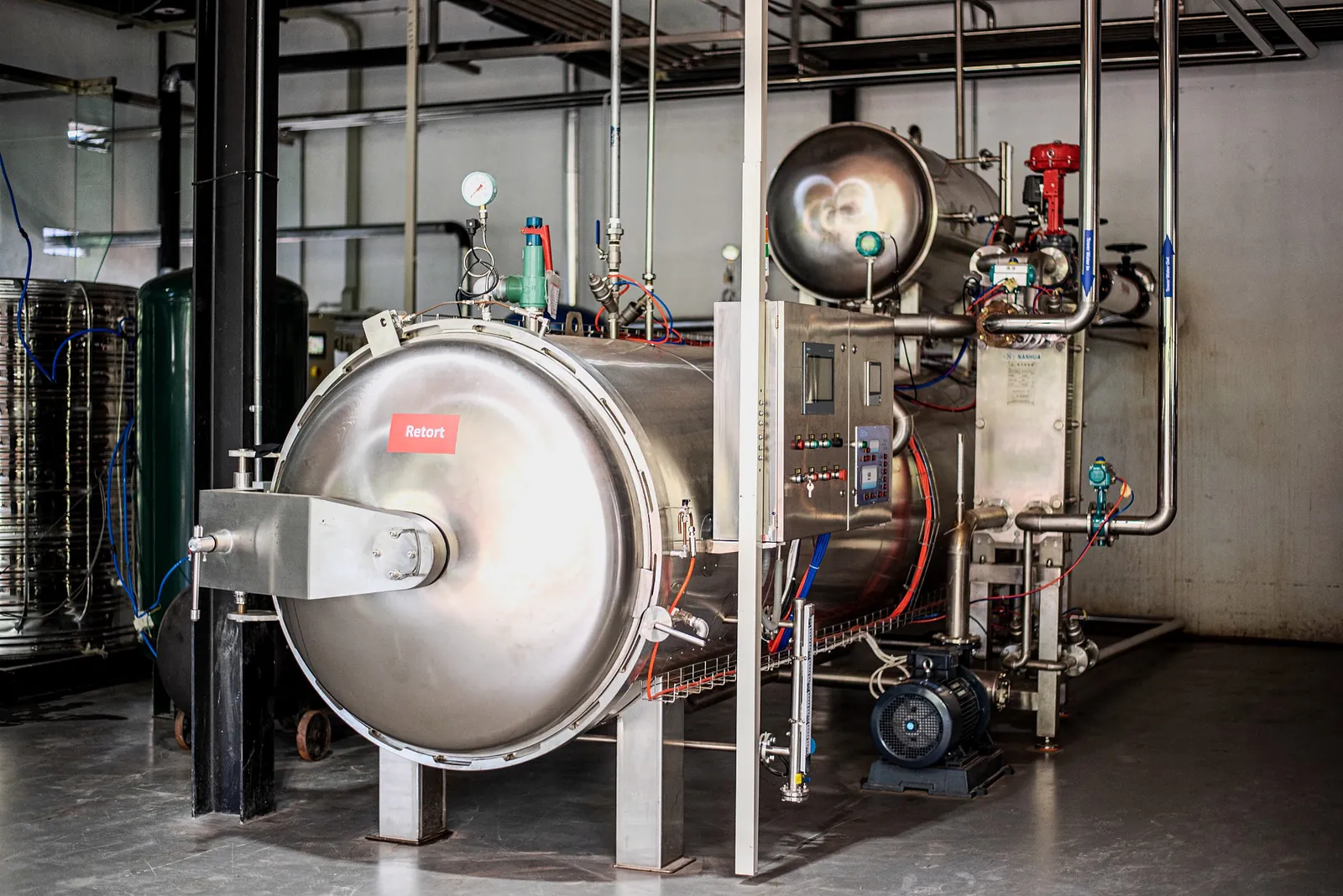
We only do the last one. On our line, still coconut water is hot-filled into two-piece aluminium cans with nitrogen dosing, seamed, then sterilised in the retort, which gives a shelf-stable drink with no preservatives and no cold chain between Sri Lanka and your warehouse. If the difference between those routes matters to your recipe, our guide to hot-fill vs cold-fill goes through it properly.
Any heat step is a flavour decision as well as a safety one. That is why the only samples worth judging are ones that went through the finished process, in the finished can.
What we make
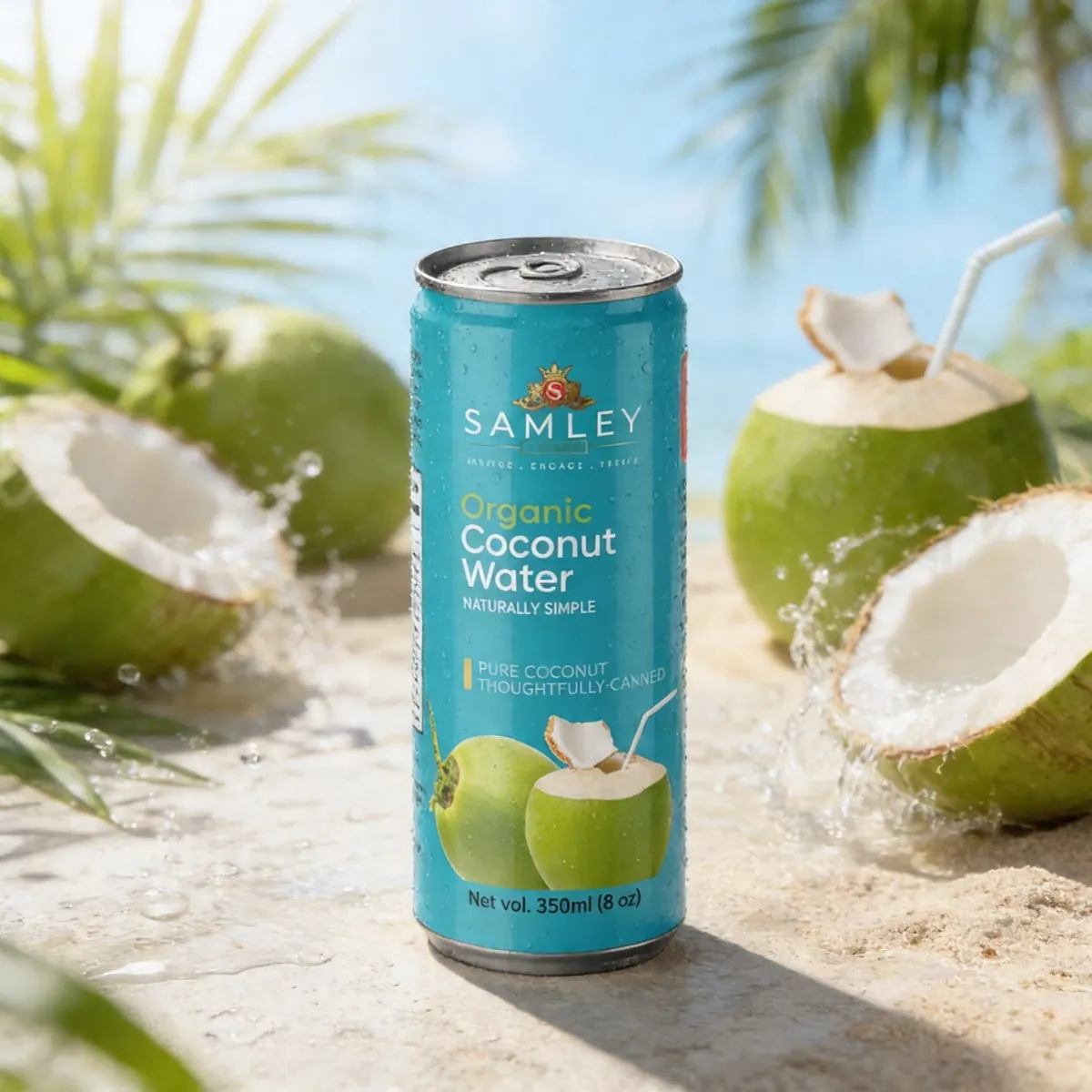
We sell organic coconut water and organic king coconut water, each a single ingredient with nothing added, and for brands we fill coconut water from certified sources into cans on our own line. That gives you three ways in, all set out on our coconut water co-packing page: our proven recipe under your label, your own formula (or one our blending team develops with you, including flavoured versions), or a finished white-label product.
The practical parts:
- Cans: 250 ml and 355 ml, with cans and lids sourced by us.
- Sleeves: your artwork on a full-wrap shrink sleeve that we import and apply, from 10,000 per design.
- Run size: from 10,000 cans per flavour, with 50,000 preferred.
- First run: roughly six to eight weeks.
- Shelf life: we quote 18 months ambient; the figure for your drink is confirmed by testing.
- Samples: free.
- Markets: we ship to more than 25.
Our site holds FSSC 22000, FDA registration and USDA and EU Organic certification, and we are adding the canning line to that existing scope now, so ask us where it stands for your drink and your market.
If you would like to taste before you talk, try our organic king coconut water and organic coconut water. For the consumer side of thambili, what it is and who should go easy on it, we wrote a separate king coconut water guide.
Eight questions to ask any Sri Lankan coconut water supplier
Take these to your first call with any supplier, us included.
| Question | Why it matters | A good answer sounds like |
|---|---|---|
| Which variety, and at what harvest age? | Sugar, acidity and minerals shift between six and eight months | A named variety and a target maturity window, not "young coconuts" |
| Is it single-strength, and is anything added? | It decides your ingredient statement and your taste | "Single ingredient", matching the spec sheet word for word |
| How does it become shelf stable? | Coconut water is a low-acid drink | A named process and how commercial sterility is controlled each batch |
| What does the organic certificate cover? | A company certificate is not the same as product scope | The certificate, its scope, and the current audit date |
| How do you handle a short year? | Last year's rainfall sets this year's crop | A supply plan, with honesty about king coconut seasonality |
| What is the minimum, and what drives it? | Can size, sleeve and run length move the number | A quote per project with the cost drivers laid out |
| Can I see the line running? | Photos and spec sheets are easy | Yes, ideally during a production run |
| Are samples made on the production process? | Fresh-cut and retorted water taste different | Samples filled and sterilised in the final can format |
The short version
Sri Lankan coconut water is a real option for a brand, and king coconut is the part most closely tied to the island. It rewards buyers who treat variety, harvest age, climate and process as part of the spec. If that is how you want to work, send us the drink you have in mind: coconut or king coconut, can size, rough volumes and your market. We will come back with samples from our line and a clear quote through our coconut water co-packing team.