
The most important number in your drink's specification isn't the sugar content or the cost per can. It's 4.6.
That's the pH line that decides how your drink has to be filled, whether it needs a pressure vessel after filling, and which regulations it falls under. Hot fill vs cold fill sounds like a question about temperature. In practice it's a question about acidity, carbonation and what you're willing to trade in flavour for shelf stability. Get it right before you order samples, because changing it later means changing the recipe.
Where your drink sits: pH 4.6
US food law sorts shelf-stable drinks by acidity. A low-acid food is one with a finished equilibrium pH above 4.6 and a water activity above 0.85. Drinks are mostly water, so for a still drink the pH is the number that decides. An acidified food is a low-acid food brought to pH 4.6 or below by adding acid. The same rule explicitly leaves carbonated beverages out of the acidified category.
Why 4.6? Because of Clostridium botulinum. FDA's guidance on low-acid juices names acidification to pH 4.6 or below as one of the controls that stops it growing and producing toxin. Above that line, heat has to do the work that acid can't.
Where does your drink sit? Measure it, don't guess. Coconut water, for example, ranges from about pH 4.78 to 5.71 depending on the nut's maturity, which puts it on the low-acid side. Add citric acid or lemon to a tea and the pH drops, but whether it crosses 4.6 is something a lab confirms on your finished formula, not something to estimate from the ingredient list.
Hot fill, in plain terms
The drink is heated, filled while hot, and sealed. The heat of the liquid treats the inside of the container and the lid. University of Minnesota Extension's guidance for small food businesses shows how time and temperature trade off: the hotter the fill, the shorter the hold. It also limits the simple hot-fill-hold method to products at pH 4.1 or lower, which is a useful reminder that hot fill on its own is a tool for acidic products.
Cans add a twist. A two-piece aluminium can is thin, and a still drink has no carbonation pushing outward to hold the walls firm. As hot liquid cools after seaming, the pressure inside drops. The fix is a drop of liquid nitrogen dosed just before the lid goes on. Nitrogen expands roughly 700 times as it turns to gas, which pressurises the container so it stays rigid on the pallet, and because nitrogen is inert it pushes oxygen out of the headspace too. That's why you'll see "hot-fill + N2" on a still-drink spec.
Hot fill doesn't work for sparkling drinks. Heat drives the gas out, and as one beverage lab puts it, carbonated beverages cannot be hot filled.
Low-acid drinks: where retort comes in
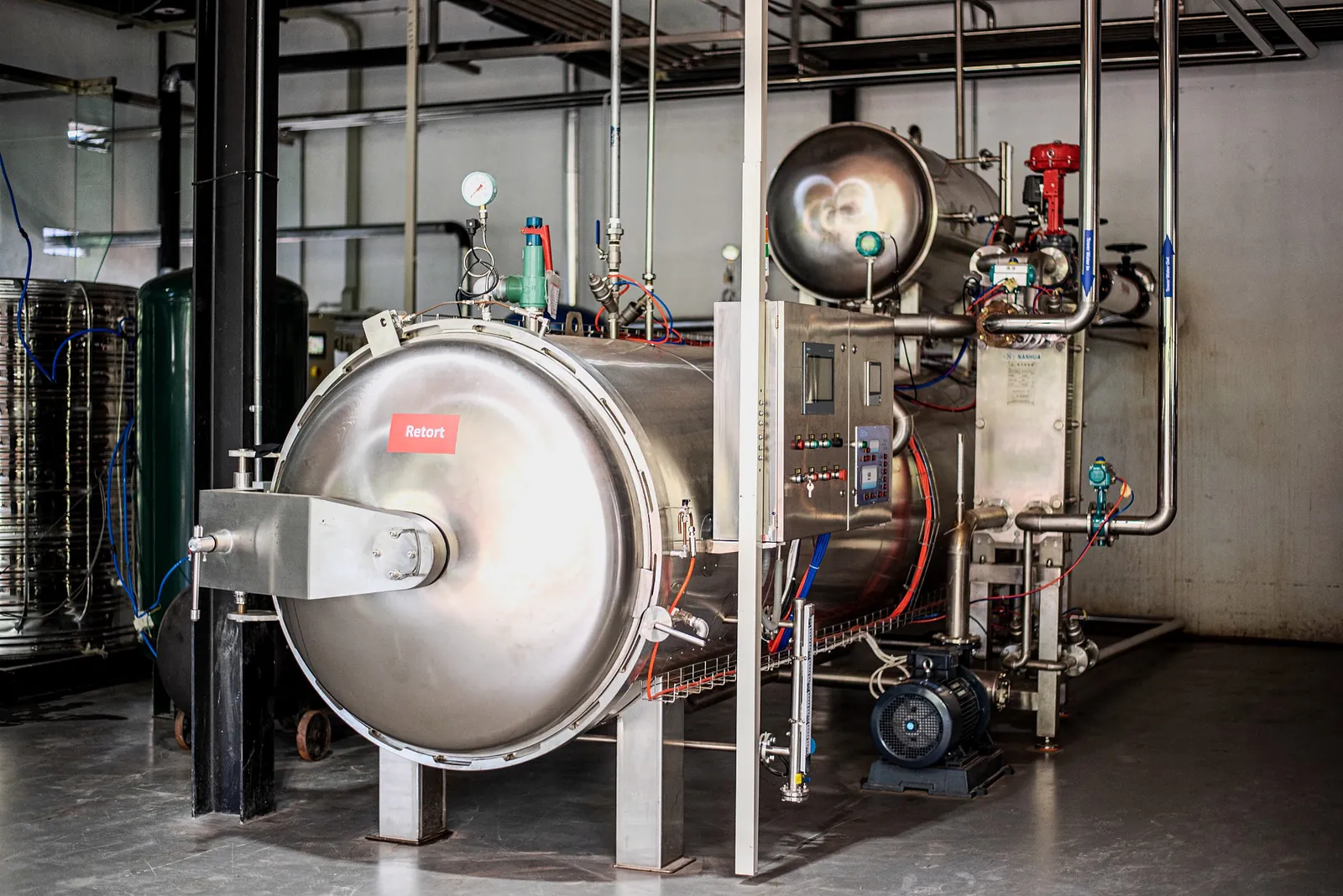
If your still drink sits above pH 4.6 and you want it on an ambient shelf, filling it hot isn't enough. It needs a thermal process that reaches commercial sterility. On a canning line like ours, that means a retort: sealed cans are heated under pressure, typically at 121°C or higher.
"Commercial sterility" is a precise phrase, not marketing. FDA defines it as the condition in which the food is free of microorganisms capable of reproducing under normal non-refrigerated conditions, and of viable organisms of public health significance. It doesn't mean nothing is alive. It means nothing that matters can grow in a sealed can on a warm shelf.
The gap between "pasteurised" and "commercially sterile" is not academic. In 2006, botulism cases in the US and Canada were traced to a carrot juice that had been pasteurised, but not heated enough to destroy the spores of the most heat-resistant type of C. botulinum. A low-acid drink needs a process designed for spores.
That process isn't improvised on the factory floor. US rules require retort schedules for low-acid foods to be set by qualified people with expert knowledge of thermal processing, and a foreign processor selling low-acid canned foods into the US must register with FDA and file its scheduled processes before packing a new product. If you're exporting to the US, ask your co-packer about both. Our co-packer question list has the exact wording.
Cold fill, in plain terms
Cold fill is exactly what it sounds like: the drink goes into the can cold. For sparkling drinks it's the only route. Cold liquid holds dissolved CO2 better, and the filler uses counter-pressure, also called isobaric filling: the can is pressurised with CO2 first, then the liquid flows in while the gas vents, so the drink doesn't foam and lose its fizz on the way in.
Here's the misconception worth correcting. Carbonation is not a preservative. Yeasts and some bacteria grow without oxygen and can spoil carbonated drinks. A cold-filled drink gets its stability from the recipe and what happens around the fill: acidity, preservatives such as sodium benzoate and potassium sorbate, or a tunnel pasteuriser that heats the sealed cans with hot water after filling. A low-acid still drink can't rely on cold fill alone.
Flavour, preservatives and shelf life
Heat costs something. Tetra Pak's coconut handbook notes that indirectly heated coconut water shows more browning and a more cooked taste, and that coconut water's colour can drift from clear towards brown or pink in storage. Over-process a delicate cold brew and you cook out the aroma, which is why we'd rather fit the process to the recipe than the other way round.
The trade runs the other way on the label. A drink that reaches commercial sterility in a sealed can doesn't need a preservative to stay safe at room temperature, which matters if your brand promise is a short, clean ingredient list. A cold-filled still drink needs one of the stability levers above instead.
As for shelf life: the process doesn't set it, your formula does. Two drinks through the same retort can age differently. For a reference point, we quote an 18-month ambient shelf life for our canned drinks; yours should be set by testing yours. Budget for shelf-life testing on the finished product before you print a best-before date.
Hot fill vs cold fill at a glance
| Hot fill (+ N2 in cans) | Hot fill + retort | Cold fill + CO2 (isobaric) | |
|---|---|---|---|
| Suits | Still, acidic drinks (measured pH 4.6 or below; above about 4.1 the process must be validated) | Still, low-acid drinks (pH above 4.6) | Carbonated drinks |
| What keeps it safe | Acidity plus heat at filling | A validated thermal process reaching commercial sterility | Acidity, plus preservatives or post-fill pasteurisation |
| Why the gas | Nitrogen keeps the thin can rigid and displaces oxygen | Same | CO2 is the product: it's the fizz |
| Flavour risk | Some heat impact on delicate aromatics | Highest heat load; cooked notes and colour shifts are possible | Lowest heat impact |
| Preservatives | Depends on the recipe | Not needed for safety at ambient | Commonly used |
| US paperwork to ask about | Acidified foods rules may apply if acid is added | Canning establishment registration and process filing | Carbonated drinks sit outside the acidified foods rule |
Which one is your drink?
- Sparkling tea, soda, sparkling water, energy drink: cold fill with CO2 under counter-pressure. Then decide how the recipe stays stable: acidity, preservative, or pasteurisation.
- Still lemon iced tea or clear juice drink, measured at pH 4.6 or below: hot fill, with nitrogen dosing in cans. Below about 4.1, hot fill alone can be enough; between 4.1 and 4.6 the process needs validating for your recipe, and in the US the acidified-foods rules may apply.
- Coconut or king coconut water, and any still drink measured above pH 4.6: hot fill followed by retort to commercial sterility. Check plant milks and milky coffees carefully; test before assuming. If you're weighing coconut water sourcing, our guide to Sri Lankan coconut water covers the origin side.
- Not sure: have the finished formula's pH measured before you request samples. It's a quick lab test, and it sets the route for everything after it.
How it works on our line
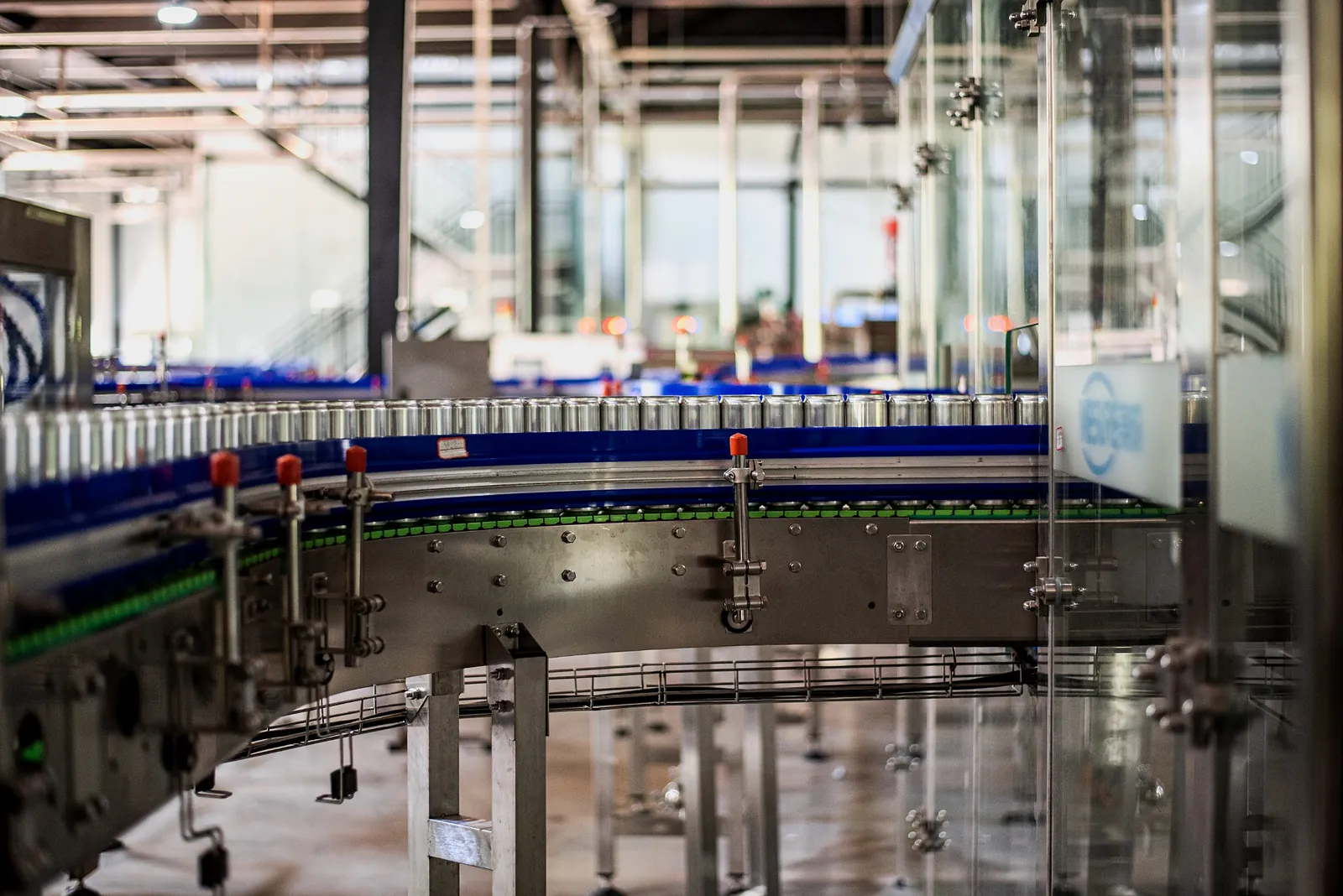
We run both methods on one canning line in Sri Lanka. Still drinks such as iced tea, coconut water and juices run hot-fill with nitrogen dosing. Carbonated drinks run cold-fill with CO2 under counter-pressure. Low-acid drinks go through our water-spray retort after seaming, and seams, CO2 and fill level are checked during the run rather than only at the end.
Which route your drink takes is settled at the specification stage, before samples, because it shapes the recipe as much as the process. And if you're still choosing between formats, the process question has a packaging twin: our comparison of aluminium cans vs glass bottles covers what the container does to your drink.
Have a finished formula and a pH reading? Send us your drink spec and we'll tell you which fill route we'd run it on, and why, before anything else.