
A 330 ml aluminium can weighed 12 grams. A 330 ml glass bottle weighed 190. Those are the containers modelled in a Carbon Trust study of soft drinks packaging, as reported in a 2023 review of beverage container life-cycle studies. That's nearly sixteen times the packaging weight before a drop of drink goes in.
Weight is the obvious difference between aluminium cans and glass bottles. It isn't the only one, and it isn't always the deciding one. This guide works through what actually changes for your drink and your business: freight, light, chilling, recycling, liners, cost and the minimums that come with decoration. One disclosure up front: we fill cans, not glass, so we've tried to be careful to show where glass wins.
Weight and freight
Take a 24-pack of 330 ml drinks. The cans add 24 × 12 g = 288 g of packaging. The bottles add 24 × 190 g = 4,560 g. You pay to move that difference on every pallet, every leg of the journey, and glass also has to be packed to survive the trip.
On carbon, the picture is more nuanced than weight alone. The Carbon Trust's own summary of its soft drinks packaging footprint study found that the low ends of the ranges for most formats were very similar, with one-way glass the exception. Note the words "one-way." Refillable glass, in a market with a working return system, is a different and much better story than a bottle used once.
Light and oxygen
An aluminium can lets no light in. Glass depends on its colour. Brewers learned this the hard way: light reacting with riboflavin and hop compounds produces the "skunky" lightstruck flavour, and the Oxford Companion to Beer notes that tasting panels can detect it after less than 10 seconds of full sunshine. Brown glass protects well against short or low-intensity exposure. Green and clear glass offer little to none. Beer is the textbook case, but if your drink carries any light-sensitive ingredient, ask your food technologist before choosing clear glass.
Oxygen is about the headspace and the seal. For still drinks in cans, a drop of liquid nitrogen dosed before seaming displaces oxygen and pressurises the can. How that works alongside hot and cold filling is covered in our guide to hot fill vs cold fill.
Chilling
Aluminium conducts heat at around 205 W/m·K. Ordinary glass manages about 0.8, according to Georgia State University's HyperPhysics tables. Add a far thinner wall and a can reaches fridge temperature sooner. The same physics works in reverse: a can also warms faster in a hand on a hot day. Neither matters much in a chilled display. Both matter at a festival, on a beach or in a hotel minibar.
Recycling: the numbers, with their years
Recycling claims are where packaging marketing gets loudest, so here are the figures with their sources and dates.
United States. The EPA's material data for 2018 puts the recycling rate of aluminium beer and soft drink cans at 50.4% and of glass containers at 31.3%. The Aluminum Association, which speaks for the aluminium industry, reported in December 2024 that 43% of US cans were recycled in 2023, against 39.6% for glass bottles, and that the average can contains 71% recycled material against 23% for glass. The methods differ, so don't mix the two sets of figures.
Europe. Aluminium beverage cans were recycled at 76.3% in 2023 across the EU, UK, Switzerland, Norway and Iceland, according to Metal Packaging Europe and European Aluminium. Eurostat data puts the EU's glass packaging recycling rate at 74.9% for 2023.
Our reading: in Europe the gap is small, and "cans recycle, glass doesn't" is simply wrong. In the US, roughly half or less of either format is recycled, whichever data set you use. The can's real advantage is value: the Aluminum Association puts used cans at $1,338 a ton against a negative value for glass, which is the economic reason cans keep getting collected. Policy moves the numbers too. After Slovakia introduced a deposit return scheme in 2022, its can recycling rate went from 58% to 91% in 2023.
Liners and the "metallic taste" worry
Your drink doesn't sit against bare metal. Cans carry a protective lining on the inside, historically epoxy resins that can contain BPA. FDA's position, last updated in April 2023, is that BPA is safe at the levels currently found in food. The EU has gone the other way: Regulation (EU) 2024/3190 bans BPA in food contact materials, including can coatings. Since 20 July 2026, most food contact articles made with BPA can no longer be placed on the EU market for the first time, with a later deadline in January 2028 for some specific uses. That lining is also why the useful question isn't "does aluminium taint the drink?" but "what is the lining made of?"
If you're selling into the EU, ask your co-packer for the liner specification in writing. If you're selling anywhere, ask anyway. It's a two-minute question that closes off a retailer's objection before it's raised.
Brand and shelf perception
This part is judgement, not data, so read it as our view. Glass still reads as craft, heritage or occasion in some categories, and a heavy bottle feels expensive in the hand. Cans read as cold, portable and modern, and a full-wrap sleeve gives you the whole 360 degrees as a billboard. Perception is powerful enough that some brewers keep clear or green glass for brand identity despite the light problem. Know what your shelf is saying before you choose.
What actually drives the cost
We're not going to quote you a price per can or per bottle. Container prices change, and any figure we printed would be out of date before you read it. What you can do is price the same five lines for both formats:
- The empty container, including the closure: a can end, or a cap and its liner.
- Freight, in and out. You pay to ship empty packaging to the filler and full packaging to the market, and glass is heavier both ways.
- Protection and losses. Dividers, stronger cases and breakage for glass; dent control for cans.
- Decoration, and the minimum that comes with it. For cans, this can be the line that decides the budget (see below).
- The process your drink needs. A low-acid drink needs retort capacity whichever container you choose, and the filler you pick has to run that process on that format.
Put those five side by side for your volumes and your market, and the cheaper format for your drink becomes clear.
Printed cans, sleeves and minimums
This is where the format decision can get made for you. A printed can is decorated at the can maker, in large runs. In late 2021 Ball announced that, from 2022, its non-contracted North American customers would need to order at least five truckloads of printed cans per SKU, about 1,020,000 12 oz cans, up from one truckload. Can makers set their own policies and they change, so treat that as an illustration, not a current quote. It shows how far a printed-can minimum can sit from a first run.
The alternative is a plain can with a shrink sleeve or label applied at filling. It solves the minimum problem, with a trade-off you should know about. The Aluminum Association's container design guide warns that plastic sleeves can cause cans to be misread as PET by optical sorters, and can ignite during the recycling process. Its advice: no PVC sleeves, make them easy to remove, and tell consumers to take the sleeve off before recycling. Ask your co-packer what sleeve material they use, and design your artwork with a "remove before recycling" line.
The format decision table
| Factor | Aluminium can | Glass bottle |
|---|---|---|
| Packaging weight, 330 ml (Carbon Trust model) | 12 g | 190 g |
| Light protection | Complete | Brown: good for short exposure. Green or clear: little to none |
| Chilling | Faster: aluminium conducts heat about 250 times better than glass | Slower |
| US recycling rate | 43% (2023, Aluminum Association); 50.4% (2018, EPA) | 39.6% (Aluminum Association, Dec 2024 report); 31.3% for all glass containers (2018, EPA) |
| Europe recycling rate, 2023 | 76.3% | 74.9% (EU glass packaging) |
| Recycled content (Aluminum Association) | 71% average | 23% average |
| Short-run decoration | Plain can plus sleeve or label; printed cans carry large minimums | Labels applied to the bottle |
| Shelf signal (our view) | Cold, portable, modern | Craft, heritage, occasion |
| Best case | Export, freight-sensitive, outdoor, light-sensitive drinks | Premium or on-trade positioning, markets with refillable glass |
Choose cans if you're shipping long distances, your drink is sensitive to light, you're selling into cold or outdoor occasions, or you need a short first run with full-wrap branding.
Choose glass if your category expects it, your brand story leans on weight and tradition, or you're selling into a market with a working refillable-bottle system.
Where we stand
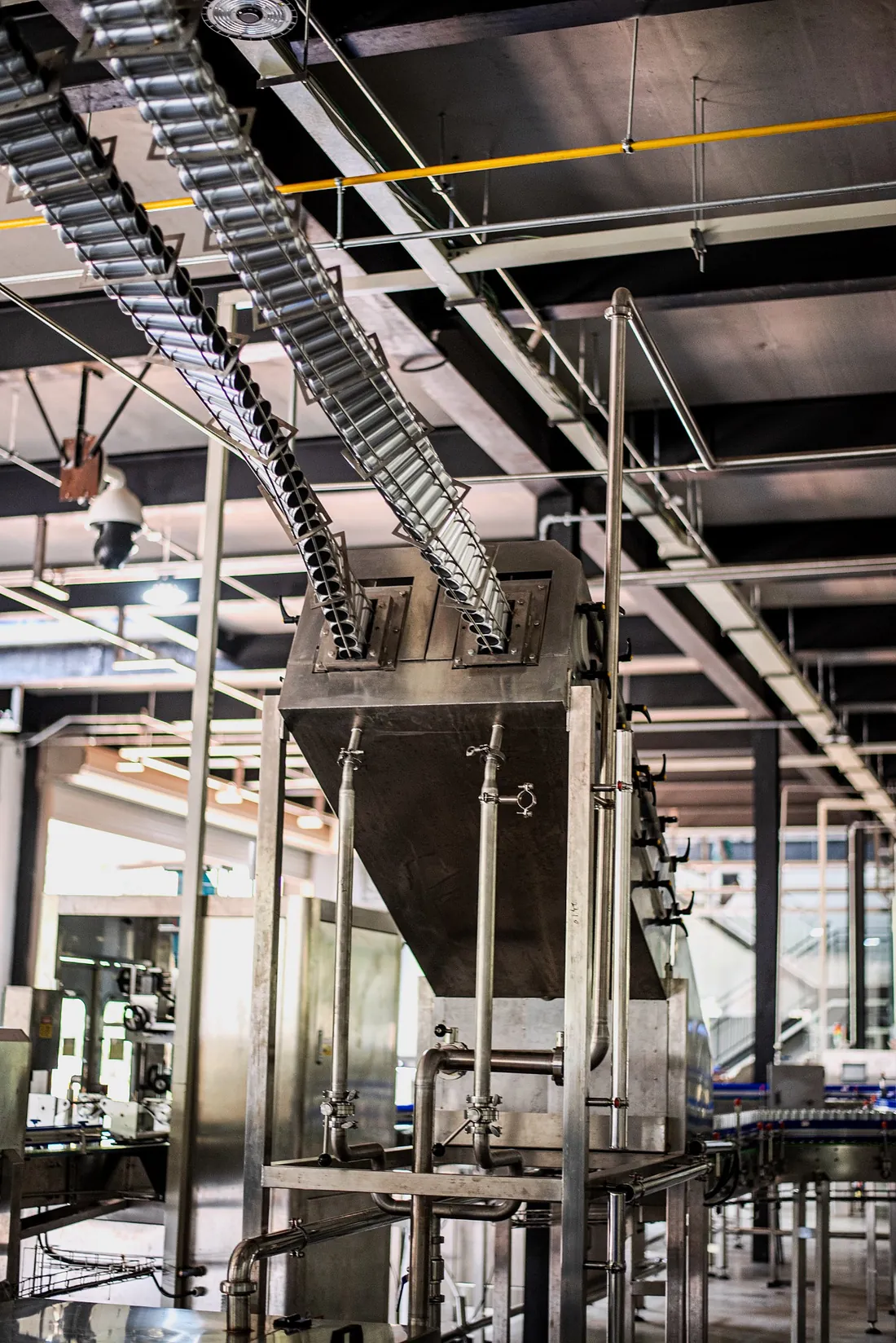
We don't fill glass. Our line runs two-piece aluminium cans in 250 ml and 355 ml, and full-wrap shrink sleeves are applied in line. That means a small brand doesn't need to commit to a printed-can minimum to launch: our sleeves start at 10,000 per design and a run at 10,000 cans per flavour, and the one set-up cost for decoration is the printing cylinder for each design. Because we import the cans, lids and sleeves as part of the project, packaging sourcing stays with one partner. If glass is the right call for your drink, we'll tell you so, and we'll also tell you we're not the co-packer for it.
If cans are the right call, see what our canning facility runs, then put the format, size and volumes into our co-packer question list and ask everyone the same things. When you're ready, send us your drink and can size and we'll come back with the questions we need answered before quoting.