
A drinks brand ties up cash early: you pay for ingredients, cans and a production run before a single customer pays you, and you keep paying for storage, freight and promotion while the stock sells through. A good drink can still stall on cash.
Starting a beverage brand looks simple from the outside: a flavour and a label. Underneath, it is a stack of technical, legal and financial decisions, and most of them have to be made in the right order.
What follows is the sequence we would walk a founder through if they sat down with us tomorrow.
1. Concept and category
Start with one sentence: what the drink is, who buys it, where, and at roughly what shelf price. "A low-sugar sparkling tea for office fridges" is a concept. "A healthy refreshing beverage" is not.
A canner will ask one number about your drink before anything else: its pH. Above 4.6, a shelf-stable drink counts as a low-acid food under US rules, which changes how it has to be heat-treated, what has to be filed with the regulator, and which lines can make it at all. Below 4.6, the rules are different.
The category matters more than it looks. A sparkling drink and a still one are filled differently. A low-acid drink, such as plain coconut water, needs a more demanding heat process than an acidic one. A high-caffeine drink carries extra warnings in some markets. Choose the category and you have already chosen some of your regulatory work and some of your possible manufacturers.
2. Formulation, and who does it
A kitchen recipe is not a production formula. A production formula is written in grams and percentages, with targets for sugar (Brix), acidity, pH and, for sparkling drinks, carbonation, and it has to taste the same after a heat process and months on a shelf.
You have three routes: hire an independent food technologist or beverage developer, use the development team at your co-packer, or combine the two. Whichever you choose, agree in writing who owns the finished formula before work starts. Changes made to scale a recipe count too.
Budget for a nutritional analysis of the final formula. Your label depends on it.
3. Labelling for the market you sell in
Label rules are set by the country of sale, not the country where the drink is made. Three common launch markets:
- United States. The FDA's Food Labeling Guide covers the core elements: statement of identity, net quantity, ingredient list, nutrition labelling, allergens, and name and place of business. If your label, name or colour suggests fruit or vegetable juice, you must declare the percentage of juice the drink contains.
- United Kingdom. The Food Standards Agency lists the mandatory information for prepacked food, and food sold in Great Britain must carry a UK, Channel Islands or Isle of Man address for the food business, or for an importer based in the UK, Channel Islands or Isle of Man if the business is abroad. Sugar also carries a tax: the Soft Drinks Industry Levy drops its lower threshold from 5g to 4.5g of total sugar per 100ml from 1 January 2028, and brings milk-based and plant-based milk drinks with added sugar into scope. If you are formulating now for a UK launch, formulate for 2028.
- European Union. Regulation 1169/2011 sets the mandatory particulars, requires them in a language easily understood in each member state where the drink is sold, and requires a high-caffeine warning on drinks above 150 mg per litre. There is an exemption worth knowing if you make iced tea: as the Finnish Food Authority's guidance on the rule explains, the warning is not required for coffee- or tea-based drinks that include "coffee" or "tea" in their name.
Get the label checked by someone who knows the target market before you print or order sleeves. Reprinting is the expensive way to learn.
4. Packaging format
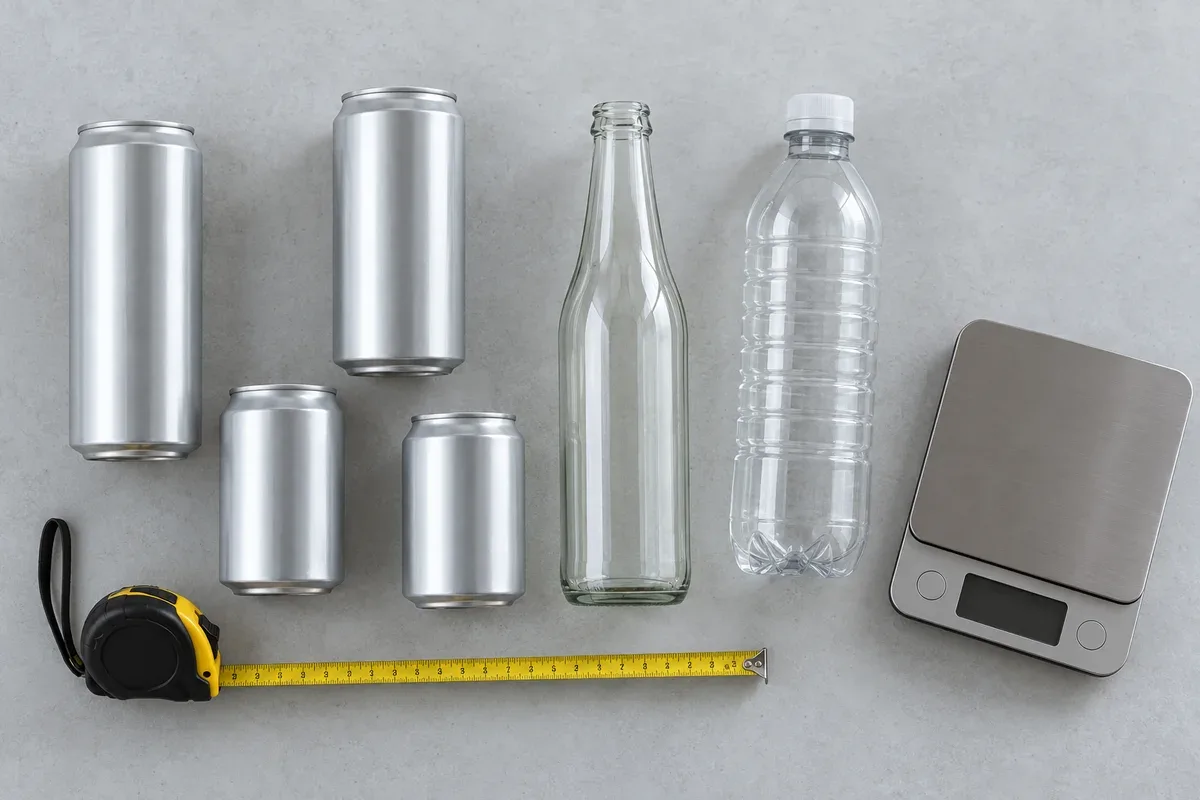
Can, glass or PET; 250 ml or 355 ml; printed can or sleeve. Each choice moves your costs, your freight weight, your shelf life and which co-packers can make you. We have set out the trade-offs in our comparison of aluminium cans and glass bottles. For a first run, the useful question is simple: which format lets you buy the smallest sensible quantity of packaging without looking like a stop-gap on shelf?
The checklist: decisions to make before you call a co-packer
A good co-packer, us included, can help with every item below. But the conversation is faster, and the quote more accurate, when you arrive with answers or at least a clear "not yet".
| Decision | Why the co-packer needs it | If you don't know yet |
|---|---|---|
| Still or carbonated | Sets the fill method and the line | Decide from the concept; it is rarely neutral |
| Approximate pH and main ingredients | Decides the heat treatment and regulatory route | Get a bench sample measured |
| Formula status | Finished formula, rough recipe, or idea only | Say so; it changes the quote and the timeline |
| Who will own the formula | Shapes the development agreement | Settle it before development starts |
| Target market(s) | Labelling, registrations, documentation | Pick one launch market, not five |
| Pack format and size | Line compatibility and packaging orders | Choose one size for launch |
| Decoration | Printed cans and sleeves have different minimums | Ask what each costs at your volume |
| First-run volume | Sets the price per unit and the minimum | Base it on orders or commitments, not hope |
| On-pack claims | Organic, no preservatives, caffeine, sugar | Only claim what you can certify or prove |
| Shelf life and storage | Ambient or chilled; export or local | Decide how long the drink must last in the channel |
5. Finding a co-packer
This is where the brand meets a factory. If the term is new, our explainer on what co-packing involves and who does what covers the basics. Then shortlist on fit: the right fill method for your drink, your pack format, a minimum you can afford, and a willingness to let you see the line. Our guide to choosing a beverage co-packer has the questions to ask on the first call.
We are one of the options, so here is exactly what we are. Samley runs its own canning line in Sri Lanka, filling 250 ml and 355 ml aluminium cans, still or sparkling. You can bring a finished formula, or have our blending team develop one with you. A run starts at 10,000 cans per flavour, samples are free, and a first run takes roughly six to eight weeks. If 10,000 cans is more than you can sell inside a year, it is worth hearing that from us now. We only fill cans, so if glass is central to your brand, look elsewhere. The beverage co-packing page lists the drink types the line fills.
6. A small first run
The first run has two jobs: prove the drink can be made consistently, and give you stock to sell and to show buyers. Size it to what you can realistically sell well inside the drink's shelf life, and to the cash you can afford to have sitting on pallets.
Hold some cans back. You will need them for shelf-life checks, retailer samples and the inevitable "can you send another case?"
7. Shelf-life testing
A shelf-life claim is a promise, and it has to be tested on the drink as produced, not the kitchen version. Oregon State University's Food Innovation Center describes the two approaches: real-time storage at the conditions the product will actually face, and accelerated storage at higher temperatures to project stability sooner. Testing covers microbial safety, chemistry such as pH and colour, and sensory quality.
For low-acid drinks, safety comes first through the heat process: US rules define commercial sterility as freedom from microorganisms capable of reproducing under normal non-refrigerated storage. Our explainer on hot-fill vs cold-fill shows how the fill method connects to that.
8. Distribution and retail
We would start narrow: direct-to-consumer, local independents, cafés and gyms, or one regional distributor. That is not a lack of ambition. It is where you learn whether people buy a second time, before you take on the costs that come with large retail.
Large grocery can carry up-front costs to secure shelf space. When the US Federal Trade Commission studied slotting fees across five grocery categories (drinks weren't among them), it found they can make up a large fraction of a product's first-year revenue. The study is old and narrow, but the lesson holds: ask what a listing will really cost before you celebrate it.
9. The cash-flow reality
Put the timeline on paper. Money leaves when you pay for development, packaging, the production run and freight. It comes back only when customers pay, and trade customers may pay weeks after delivery. In between, your stock is sitting in a warehouse costing money.
Two habits help. Plan the second run before the first one sells out, because reorders take time too. And keep enough cash back to survive a slow first quarter without discounting the brand into the ground.
None of this means don't do it. It means go in with the order of decisions clear, the label right for one market, and a first run sized to what you can actually sell.
Ready to talk about production?
If you have worked through the checklist, or most of it, send us your drink type, can size, target market and rough volumes through our beverage co-packing enquiry. If you only have a concept so far, that is fine too; tell us, and we will tell you honestly what needs to happen before a first run makes sense.